Harry Styles at Wembley review: the strange church of stadium pop
Travelling from Manchester to London for Harry Styles at Wembley Stadium on Saturday 20 June 2026, I found a pop show that was less about spectacle for spectacle’s sake, and more about the strange, communal feeling of being allowed to belong.
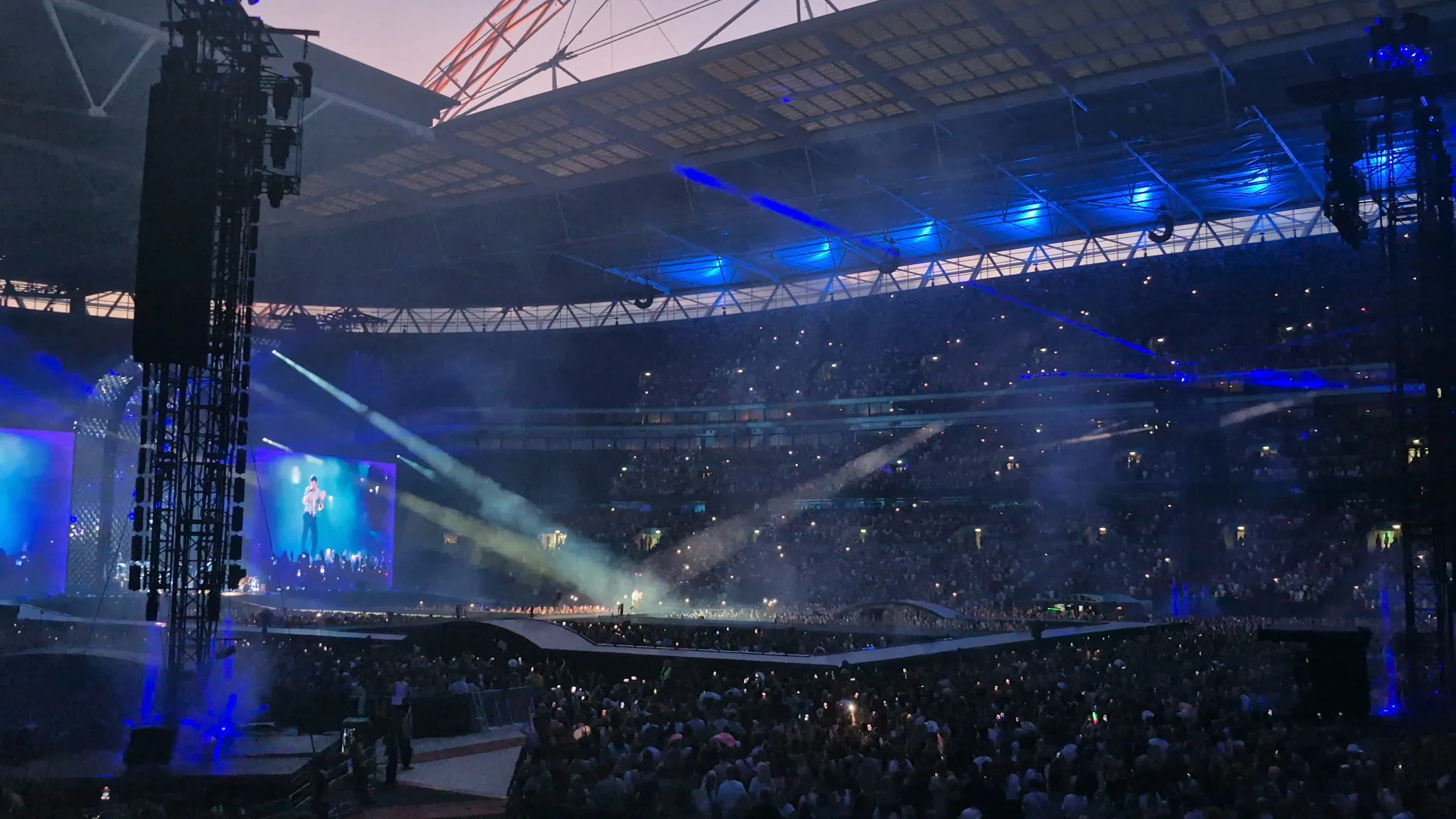
Harry Styles at Wembley Stadium, Saturday 20 June 2026.
I went to Wembley to see whether Harry Styles could make a stadium feel personal.
That sounds slightly ridiculous when you say it out loud. Wembley is not built for intimacy. It is built for finals, national anthems, security queues, mass movement, overpriced drinks and people pretending they know exactly which entrance they need while quietly panicking inside.
The last time I was there was for Oasis the year before, which came with its own kind of mythology: all lager, limbs, nostalgia and mass singalong. Harry’s Wembley felt different before he had even appeared. Softer, brighter, stranger, and much more interested in giving people permission to be seen.
Harry Styles has built a career out of doing something more delicate than simply being famous. He makes people feel included. He makes mass attention feel strangely individual, and travelling down from Manchester to London for one night, I was curious whether that would survive on a Wembley scale.
That question feels especially relevant now. We are in the era of the mega-residency: fewer cities, longer runs, bigger crowds, bigger ticket prices, bigger expectations. The biggest pop stars do not always come to you anymore. Sometimes you go to them. Harry playing a run of nights at Wembley is not just a tour stop. It is a statement about where live music is heading, and how much people are willing to spend, travel and organise their lives around being there.
So yes, I went for the songs, but I also went to see the machine around the songs: the crowd, the staging, the sense of pilgrimage, and whether a show this large could still make people feel like they belonged to something personal.
The show started before the music
Before the music even started, the show had already begun.
On the way to the stadium, the crowd was impossible to miss: cowboy hats, glitter, sequins, pinks, pastels, bright colours and outfits that had clearly been planned well before the train journey. It felt less like people were going to watch a pop star and more like they were entering a temporary world where everyone had agreed to be a little more themselves than usual.
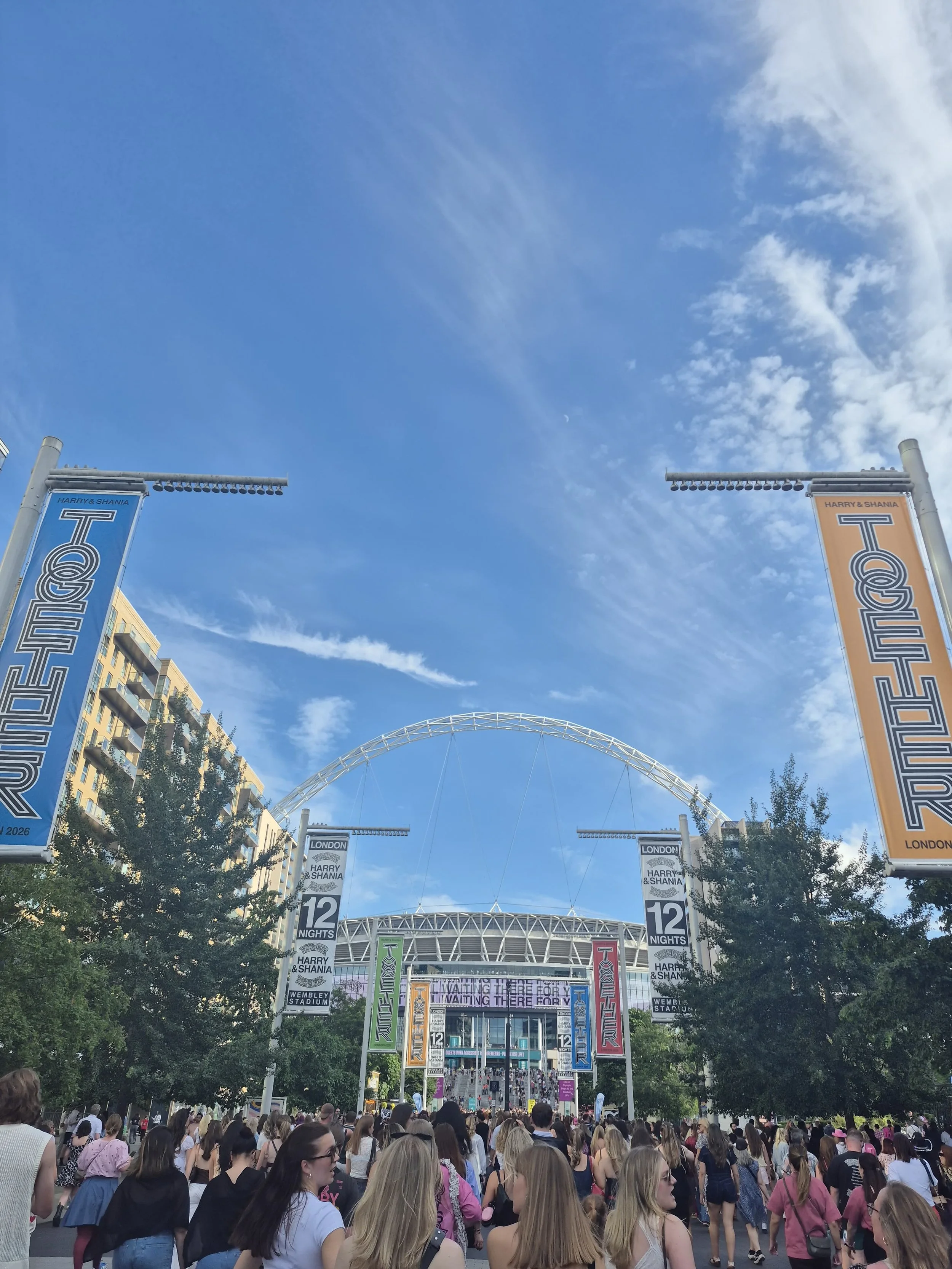
Fans arriving at Wembley before Harry Styles’ Saturday night show.
That is easy to dismiss if you are cynical. I get it. Big pop events can look absurd from the outside. But on Wembley Way, the energy was not embarrassing or forced. It felt genuinely communal. There were teenagers, twenty-somethings, parents, older fans and people who looked like they may have been there as much for Shania Twain as Harry. It was flamboyant, but it was also weirdly calm. Big energy, positive mood, not much aggro. A celebration with a good queueing system.
Even the merch queue moved faster than expected. That might not sound like proper music criticism, but it matters. A stadium show is not just what happens on stage. It is the whole operation: entry, signage, queues, sound, toilets, bars, crowd movement, how safe people feel, how quickly the outside world drops away. On that front, Wembley felt surprisingly easy. Well signed, friendly staff, minimal stress. My only complaint is that the beer selection could have been better, which is maybe the least poetic sentence ever written about Harry Styles.
Shania Twain was more than a warm-up
Shania Twain opened with the kind of warmth that only someone with actual songs in the cultural bloodstream can bring. She was not just a warm-up. She was a reminder that pop longevity has its own gravity.
When she played ‘You’re Still the One’, the people around me started rising almost involuntarily. My friend turned to me and said, ‘I’m gonna have to stand up,’ which is probably the most honest review of that song possible.
There were moments where the performance felt a little loose. At times, she seemed slightly ahead of the band, and the stadium reverb did not always flatter her voice, but there was also something generous about her presence. She got people singing, she acknowledged Harry, and she brought a different generation into the room. If Harry’s crowd is often talked about as young and internet-fluent, Shania made the night feel broader than that. A bit country-pop, a bit camp, a bit mum-and-daughter, a bit everyone.
When Wembley felt small
Before Harry appeared, Elvis Presley’s version of Simon & Garfunkel’s ‘Bridge Over Troubled Water’ played against a black screen. It felt like a private backstage moment made public, as if we were being brought into the breath before the show rather than simply being asked to scream on cue. The song choice also felt deliberate. There is a story Harry has told recently about playing ‘Bridge Over Troubled Water’ for a friend who had just discovered Paul Simon, and being reminded of how a song can stay with someone for life. In that context, hearing it before Wembley did not feel like filler; it felt like a quiet statement of intent.
The band arrived, the atmosphere tightened, and then came a surreal garden visual, a voice asking, ‘Harry, are you coming out tonight?’, and the kind of scream that turns a stadium from a building into a body.
When he finally appeared, he looked like he meant business: suit, yellow tie, and the casual confidence of someone who knows exactly how much noise he can summon with one movement. After ‘Golden’, he grinned and told the crowd: ‘My name is Harry, and you can bet your ass I’m coming out tonight.’
The beginning felt intimate, which was the first surprise. Not small, exactly. Wembley cannot be small. But he has a way of bringing the room down to his level without pretending the scale is not there. He winks, skips and talks without barking, letting the crowd be loud, emotional, silly, soft, or whatever else they need to be.
Early on, his message was simple: be kind, drink water, call your friends, sing if you need to, dance if you want to, and do not feel stupid for feeling things. In a stadium full of screaming people, that kind of thing could easily sound rehearsed or hollow. It did not. It landed because the crowd already seemed to believe it.
The crowd as the main character
That might be the key to why Harry works at this level. His fans do not just admire him. They seem to trust him.
There is a clear cult following, but not in a frightening way. More like a safe church. Not the old kind with judgement, hard pews and someone telling you to sit still, but something softer and stranger: a room where sincerity is not embarrassing, feeling things are allowed, and everyone already knows the words.
That could sound overblown, but it is hard to avoid when you are there. The call and response in ‘Watermelon Sugar’ had the structure of ritual: Harry sings, the crowd throws back ‘high’ with near-religious commitment. During ‘Music for a Sushi Restaurant’, he treated the audience like a choir, pulling sound out of them with a few gestures. During ‘Treat People With Kindness’, the stadium loosened into something like a wedding reception, a family party and a very expensive conga line, literally. From where I was sitting, I could see fans in the standing area forming one, which is probably the most accurate physical expression of that song imaginable.
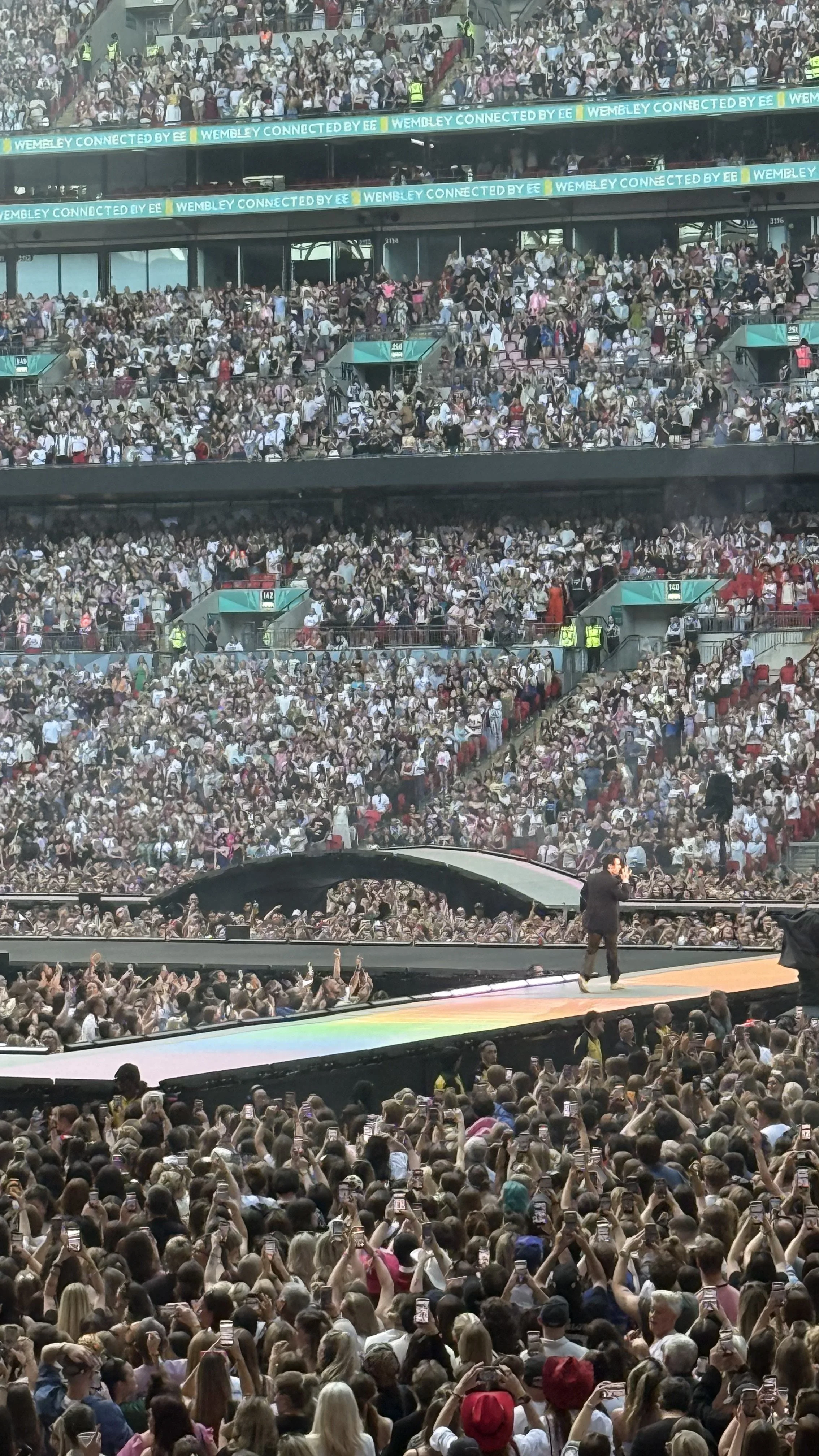
Harry Styles on the Wembley catwalk, with the crowd becoming part of the show.
And then, just to personally target me, he folded in Talking Heads’ ‘This Must Be the Place (Naive Melody)’. When that familiar ‘Home is where I want to be’ line came through, I suddenly found myself becoming the loudest person in my row while the diehards around me carried the Harry parts. There is nothing more humbling than realising you are the niche dad at a Harry Styles concert, even when you are not a dad.
Where the production worked, and where it drifted
Musically, the show was more interesting than a simple hits parade. There is a critical conversation around Harry’s newer material being more understated and less immediate than the bulletproof pop moments of ‘As It Was’ or ‘Watermelon Sugar’, and I can see why: away from the noise of a stadium, some of the newer songs feel more like atmosphere than instant hooks. Live, though, the band gave them shape. The brass cut through, the backing vocalists pulled the songs into deeper water, and the crowd gave the less obvious moments a physical force they might not have on record.
There were psychedelic transitions that made me wonder whether Kevin Parker had been smuggled into the creative direction somewhere. There were moments of disco, soft rock, house, gospel, theatre, and late-night looseness. At its best, it felt like Harry had invited a stadium full of people to listen in on a band enjoying itself.
Not everything worked. Some of the newer, more experimental sections occasionally drifted. A stadium is a difficult place to make a club impulse feel natural, and when the songs leaned into extended grooves and rave-adjacent energy, there were moments where the concept felt clearer than the emotional payoff. But even those lulls were usually rescued by pacing. Just when the energy softened, he would pull the room back up, introduce the band, shift the pace, or let the crowd take ownership of the moment.
That is performance intelligence: not just charisma, but a clear understanding of how to shape a night so the crowd never drifts too far from him.
‘Fine Line’ and the emotional contract
The emotional centre of the night, for me, was ‘Fine Line’.
The arrangement gave the song real weight. Strings, brass, vocals and drums built into something that felt less like a ballad and more like a storm arriving slowly. It gave the song a depth that went beyond surface-level sadness. Around me, people were not just filming it. They were inside it.
A young woman in front of me, who had travelled from Canada with her mum, became emotional during the song. She had ‘we’ll be alright’ tattooed on her left forearm, and told me afterwards that she had grown up with One Direction, that Harry’s music had followed her through vulnerable moments, and that ‘Fine Line’ had helped her through hard times.
That is the thing critics can sometimes miss when writing about artists like Harry Styles. The devotion is not only about attraction, celebrity or fandom as decoration. Of course, those things exist. But for many people in that crowd, the songs seem attached to private chapters of their lives. Growing up, leaving home, falling apart, feeling strange, and becoming more honest. The pop star becomes a marker for things people cannot always explain cleanly.
Harry seems aware of that responsibility. He is proud of his music, but rarely smug about it. He performs with confidence, but he also has a strange humility on stage, as if he knows the scale of the thing is absurd and sacred and funny all at once. He gets on his knees and sings to the sky. He dances like a man who knows he looks ridiculous and has decided that is part of the point. He does a lap of the stage like the not-so-secret marathon runner he is, and then bows as if he has just survived something.
It is tempting to reach for the obvious comparisons: Bowie, Elton, Elvis. The suits, the camp, the theatricality, the old-school showmanship, the emotional extravagance. There are flashes of all of that, but I am not sure those comparisons are the most useful way to understand him. Harry’s real gift is not that he is trying to become someone from the past. It is that he understands the modern pop audience as a community, not just a market.
That was clearest in the way the crowd moved together. During ‘Keep Driving’, people around the stadium knew the choreography: phones up, phones down, little movements passed from fan to fan like a secret language. The girl next to me was teaching her friend the timing. Elsewhere, a flick of Harry’s wrist seemed to mean something specific to people who had been paying attention for years. These gestures are tiny, but at Wembley they become enormous. A private joke becomes a stadium signal. A fan habit becomes part of the show.
Later, when the strings of One Direction’s ‘Night Changes’ began, the effect was instant. People who had been sitting stood up as if summoned. It felt like a homecoming. Not nostalgia as a cheap trick, but gratitude. Harry does not seem embarrassed by where he came from. He knows those songs are part of the reason the room exists.
What stayed with me
By the time he closed with ‘Sign of the Times’, the night had moved from party to sermon. His final message to the crowd was about saying yes, putting your phone down, spending time with the people you love and being open to the moments that matter when they arrive. It could have been corny, and maybe, written down, it is corny, but at the end of a huge show, after hours of collective singing, it felt earned.
I nearly choked up during ‘Sign of the Times’, which surprised me. I am a 29-year-old man who had come to Wembley partly as a writer, partly as a casual fan, partly as someone trying to understand why this level of pop still matters. I did not expect to be emotionally ambushed by the final stretch of a Harry Styles show. But the vocals held, the drums drove the song like the end of the world was approaching, and the crowd seemed to sing with the force of people trying to send something back.
Maybe that is what Wembley does when it works: it makes emotion feel public without making it feel cheap.
That is why the production question matters. I had seen some online criticism before the show about whether the staging and management of this era were matching the scale of the moment. From where I was, the answer was mixed but mostly positive. The organisation around Wembley felt smooth. The screens and lighting did not overwhelm the show. The stage did not always need bells and whistles because the crowd often supplied the spectacle. There were moments where the newer material could have used a stronger visual or musical anchor, but the best sections proved that restraint can work if the emotional contract with the audience is strong enough.
The best stadium shows do not simply make an artist look bigger. They make the audience feel bigger, too. For all the scale, the screens, the screaming and the production, the lasting image from Harry Styles at Wembley was not just Harry standing in the centre of it. It was the crowd around him: glittered, hoarse, crying, laughing, filming, dancing, holding hands, singing songs that clearly meant more to them than a night out.
That is why the church comparison kept coming back to me. Not because Harry Styles is a saint, or because pop music needs to be treated like religion, but because, for a few hours, Wembley became a place where people gathered, sang together, felt something, and left a little lighter than they arrived.
On the way out, that was what stayed with me. Not just the spectacle. Not just the hits. Not just the idea of Harry as the latest in a line of great British pop showmen.
It was the permission in the room.
To dance badly. To cry at a song. To wear the cowboy hat, the sequins or the outfit you might not usually be brave enough to put on. To sing the old One Direction song without irony. To travel from another city, or another country, because music once got you through something, and you wanted to stand near other people who understood.
That is not a small thing, and at Wembley, Harry Styles made it feel huge.
Read more from Greg
I write about music, culture, travel and creative life from Manchester and beyond.
You can read more on my Writing page, including my review of Don West at Manchester Academy 2, or get in touch if you’d like to work together.