Don West at Manchester Academy 2: an Australian soul export finds his Manchester crowd
In his first Manchester show, Don West brought falsetto, brass, swagger and slow-burning soul to Academy 2, with a performance that suggested bigger rooms may not be far away.
Manchester Academy 2, Thursday 28 May 2026
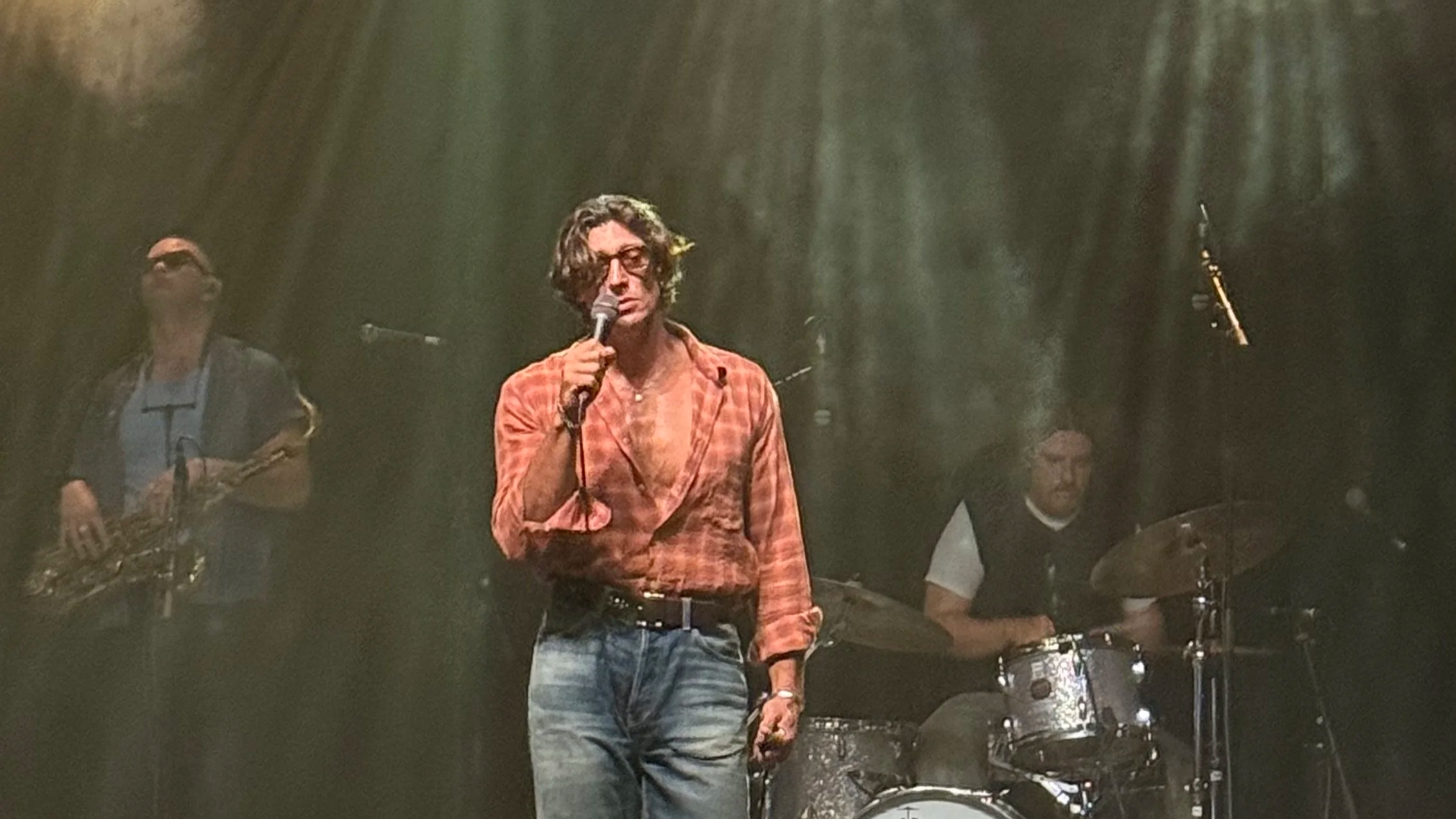
Don West performing at Manchester Academy 2, Thursday 28 May 2026.
There’s something strange about watching an Australian artist on the other side of the world. You walk into a room in Manchester wondering how many accents from back home you’ll hear at the bar, how many people are there because they’ve followed the artist from Sydney, and how many have simply found themselves pulled into the orbit of someone who seems to be gathering momentum fast.
For me, there was another layer to it. This was the first gig I had gone to on my own since moving to Manchester. Back in Australia, that sort of thing never really bothered me. You go, grab a drink, watch the band, maybe talk to someone, maybe don’t. But in a new city, even something familiar can feel oddly exposing.
Then, in the queue, I met James and his younger brother Michael, who had come up from Liverpool, along with James’ girlfriend Ellie. They took me in like it was the most normal thing in the world. Within minutes, what had started as my first solo gig in Manchester felt more like being reminded of what Northern England does very well: making strangers feel like mates before the first pint is finished.
It also helped that we were there to see an Australian artist who seems to understand the value of warmth, a trait the northern weather might not always be known for, but the people definitely are.
Don West’s Manchester show at Academy 2 had a quiet sense of occasion about it. Originally scheduled for The Blues Kitchen before being upgraded to Academy 2 due to demand, this was not a gig that felt like a tentative first visit. It had the energy of an artist testing whether the room he had been given was already too small.
From the opening stretch, West’s vocals gave the set its centre of gravity. His falsetto arrived early, smooth but not flimsy, sitting above the band with the kind of control that makes you realise pretty quickly this is not just another handsome Australian bloke with a vintage soul playlist and a good pair of sunglasses. There is range there, but more importantly, there is restraint. He knows when to pull back, when to let the groove carry the room, and when to lean into the upper register just enough to remind everyone that he can.
The swagger came early too. “Can I get a little love?” he asked, less like a frontman begging for attention and more like someone already aware he had it. It would be easy to roll your eyes at that sort of thing if it did not work. But it did.
West has clearly built a persona around the artist he wants to become: part soul revivalist, part Sydney surfer who ended up at ‘kick-ons’ and fell deeply, perhaps dangerously, in love with old records. Dressed in 70s-style jeans, a loose red button-up shirt with the sleeves rolled up and only half done up, plus a pair of vintage-looking sunnies he never took off, he looked every bit the part. Whether that makes you laugh, swoon or both probably depends on where you were standing.
At one point between songs, an Australian voice in the crowd yelled “take it off”, which landed because everyone in the room seemed to understand the joke. West is a good-looking bloke from Australia singing slow-burning soul songs with his chest half out and his sunglasses on indoors. He knows it. The crowd knows it. The performance does not exactly run away from it.
The funniest proof of that was standing right next to me. A woman who appeared to be there with her boyfriend or husband spent a good chunk of the set screaming and swooning like she had been personally victimised by his cheekbones. Her screams said it all, really. The man has presence.
There were moments where it felt like he had transported the room somewhere closer to the 1970s than 2026. On Julia, especially, there were flashes of Marvin Gaye in the phrasing and temperature of the performance. Not imitation exactly, but influence worn loudly enough to be noticed. His songs seem less like straightforward love songs and more like songs for people in love, people who love being in love, and people who enjoy the drama of pretending they do not.
That is probably the thing that makes West interesting. There is a sexual energy to the music, but it rarely explodes. It builds tension instead. Everything smoulders. The electric guitar kept the rhythm clipped and purposeful, the keys added warmth, and the rhythm section gave the songs enough shape without crowding them. The saxophone and trumpet were especially good value, moving side to side in sync and giving the stage some of its best visual energy.
Actually, so do the horns in general. Introduced brilliantly as ‘the horny boys’, because apparently subtlety was never going to be the brand here. The brass gave the set some of its best lift, especially when the songs threatened to settle too comfortably into the same tempo and mood.
And that is where the fair criticism sits. For all the charm, control and charisma, parts of the set did blur slightly. West has found a sound, no doubt, but you occasionally got the sense of an artist still figuring out how far he can stretch it. Some songs slid into one another without quite enough distinction, and there were moments where the stillness on stage raised the question of whether it was intentional restraint or simply a live show that could use a touch more movement from its frontman.
That is not a disaster. If anything, it is the sort of problem an artist has when the raw ingredients are already strong. The vocals are there. The band is there. The look, confidence and world-building are there. But at this level, with this much natural charisma, you do find yourself wanting a bit more theatre. The keys player picked up a tambourine at one point, but you almost wanted West himself to take it and use it to pull a little more energy out of the room. Female backing vocals would have lifted certain moments beautifully too. The show was good, but you could feel the places where it could become great.
Still, when it worked, it really worked.
The call and response of ‘so high’ had the crowd exactly where he wanted them: singing back, fully bought in, and seemingly happy to be led wherever he wanted to take them. There was a trance-like quality to the room at points, although depending on your level of cynicism, you could argue that trance occasionally flirted with stillness. Soul music in 2026 has a difficult job. In an age where attention spans have been battered by phones, algorithms and chorus-first songwriting, how do you bring slow-burning Motown influence to a modern crowd without losing momentum?
West’s answer, for the most part, is confidence. He does not rush. He does not seem interested in begging for cheap reactions. He lets the songs breathe, lets the groove do its work, and trusts that people will come with him. Most of the time, they did.
There is also something refreshing about seeing an Australian artist occupy this lane so convincingly, particularly at a time when the conversation around Australian music can feel anxious. For all the talent coming out of Australia, there is still a sense that new artists are fighting harder than ever to cut through internationally, especially in a global streaming landscape where local scenes can be flattened by whatever the algorithm decides to serve next.
That context matters because West does not sound like an artist trying to sand himself down for export. Australia has plenty of great singers, plenty of indie bands and plenty of festival-ready acts, but there are not many artists working this particular space with the same level of conviction. The Teskey Brothers are an obvious comparison in terms of soul influence, but West feels less earthy, more flirtatious, more pop-adjacent. You can imagine him on bigger festival stages, but you can also imagine him making complete sense next to someone like Olivia Dean, where classic songwriting, modern production and old-school warmth all meet in the middle.
That might be the more interesting question: how far does he want to go? Because the bones are there. The voice is there. The crowd control, at times, had the early signs of something much bigger. Not Freddie Mercury, obviously. Calm down. But there is an instinctive understanding that an audience wants to be led. Even when he seemed like a man perhaps a little too in love with himself, it was hard to hold it against him. Annoyingly, that was part of the charm.
Ending slowly was a risk. For an artist pushing beyond Australia and into bigger international rooms, you wonder whether a more explosive final moment would have left a stronger mark. But maybe that is the point. Don West does not seem desperate to win people over in the obvious way. He would rather hold the tension, dim the lights, and leave the room leaning in.
Academy 2 was a fitting setting for that kind of performance: intimate enough to feel close, big enough to suggest ambition. But whether it will be the right-sized Manchester room for him next time is another question.
For a first Manchester show, this felt less like a tentative introduction and more like a soft launch for something larger. It was not perfect. It could be tighter, braver and more dynamic. But Don West has the rare thing you cannot fake: presence. He has a voice that makes people stop talking, a band that understands the assignment, and enough old-school soul in his bones to make a Thursday night in Manchester feel strangely timeless.
You hate that you love it a bit.
But you do.
This piece is part of Notes From Manchester, a series on live music, culture and creative life from Greg Corrigan.
Greg Corrigan is a British-Australian writer, content strategist and musician raised in Perth and based in Manchester. His work has appeared in The Music, where he covered Australian and British artists, festivals, emerging scenes and new releases.